Average Speed -1
A car travels from Hyderabad to Bangalore, a distance of 700 km, in 10 hours. The average speed of the car in m/s is:
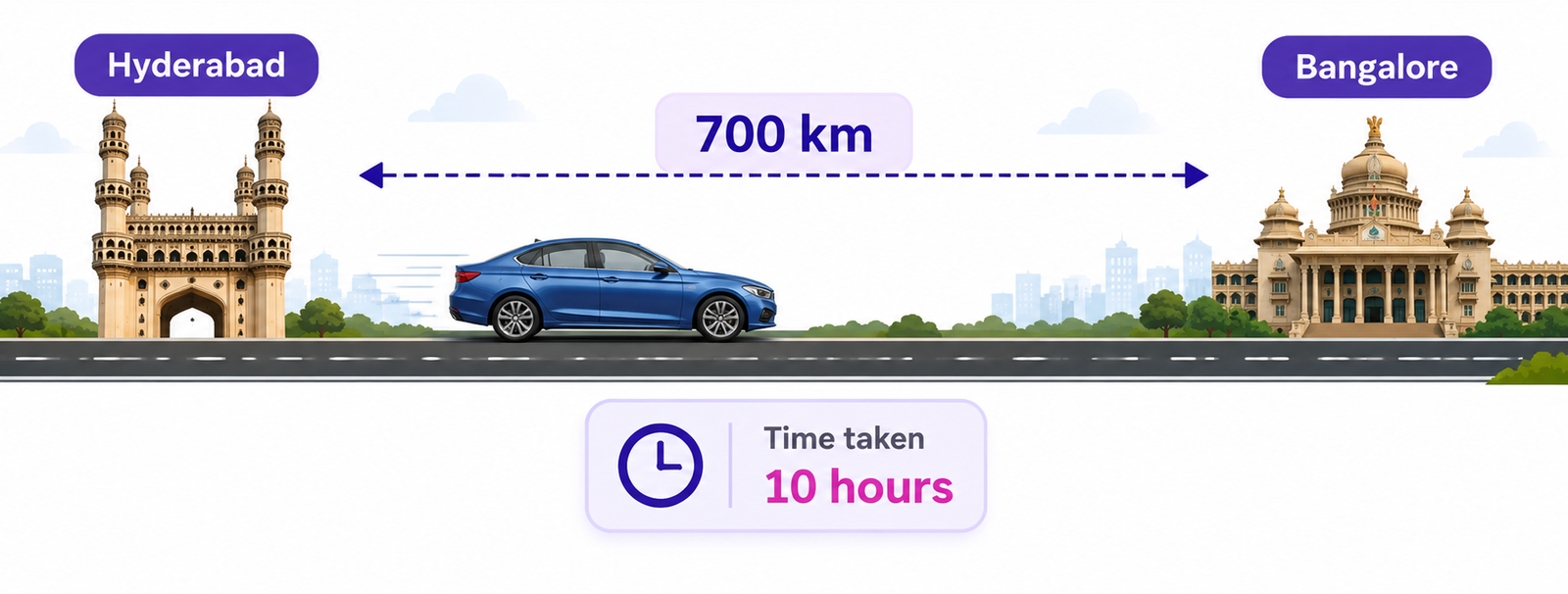
Show Answer & Solution
✓ Correct Answer: A — 19.44 m/s
🧠 Concept
Identify the model: The problem gives the total distance travelled and the total time taken. Therefore, we can directly use the formula for average speed.
Key idea: Average speed is the ratio of total distance travelled to total time taken.
vavg = Total distance Total time
Since distance is given in km and time in hours, first calculate the average speed in km/h.
vavg = 700 km 10 h = 70 km/h
To convert km/h into m/s, multiply by 5/18.
1 km/h = 5 18 m/s
Common trap: For km/h → m/s, use 5/18, not 18/5.
💡 Solution
Given:
Total distance = 700 km
Total time = 10 h
Average speed:
vavg = 700 10 = 70 km/h
Convert km/h to m/s:
70 × 5 18 = 19.44 m/s
A car travels 300 km in 5 hours and then 200 km in 4 hours. What is the average speed of the car?
Show Answer & Solution
✓ Correct Answer: B — 55.56 km/h
🧠 Concept
Identify the model: The car travels through two different distances in two different time intervals. Therefore, we must first find the total distance and total time.
Key idea: Average speed is calculated using total distance divided by total time. We should not take the simple average of the two speeds.
vavg = Total distance Total time
First calculate the total distance:
Total distance = 300 + 200 = 500 km
Now calculate the total time:
Total time = 5 + 4 = 9 h
Therefore, the average speed is:
vavg = 500 9 = 55.56 km/h
Common trap: Do not calculate the average speed as (60 + 50) / 2. The distances and time intervals are different, so the correct method is always total distance ÷ total time.
💡 Solution
Given:
First distance = 300 km
First time = 5 h
Second distance = 200 km
Second time = 4 h
Step 1: Find total distance
Total distance = 300 + 200 = 500 km
Step 2: Find total time
Total time = 5 + 4 = 9 h
Step 3: Calculate average speed
vavg = 500 9 = 55.56 km/h
A car travels 100 km in 2 hours and another 100 km in 3 hours. What is the average speed of the car for the entire journey?
Show Answer & Solution
✓ Correct Answer: B — 40 km/h
🧠 Concept
Identify the model: The car travels equal distances in two different time intervals. Therefore, we calculate the average speed using total distance ÷ total time.
Key idea: When distances are equal, the two speeds are generally different because the time intervals are different. We must not take the simple average of the two speeds.
vavg = Total distance Total time
Since the distances are equal: 100 km + 100 km = 200 km.
Total distance = 100 + 100 = 200 km
The total time is:
Total time = 2 + 3 = 5 h
Therefore:
vavg = 200 5 = 40 km/h
Common trap: The speeds are 50 km/h and 33.33 km/h. Their simple average is not the correct average speed.
💡 Solution
Given:
First distance = 100 km
First time = 2 h
Second distance = 100 km
Second time = 3 h
Step 1: Find total distance
Total distance = 100 + 100 = 200 km
Step 2: Find total time
Total time = 2 + 3 = 5 h
Step 3: Calculate average speed
vavg = 200 5 = 40 km/h
A car travels 100 km in 2 hours and then 200 km in the next 2 hours. What is the average speed of the car for the entire journey?
Show Answer & Solution
✓ Correct Answer: C — 75 km/h
🧠 Concept
How to analyse the problem: First identify what is given in each part of the journey. Here, the distances are unequal, but the time intervals are equal.
How to crack it: Never take the average of speeds directly unless the required condition is satisfied. Start with the basic definition: total distance ÷ total time.
vavg = Total distance Total time
For two parts of the journey, let the distances be d1 and d2, and the time intervals be t1 and t2.
vavg = d1 + d2 t1 + t2
Since the time intervals are equal, let t1 = t2 = t.
vavg = d1 + d2 2t
For each part, v = d/t, so d = vt. Therefore, d1 = v1t and d2 = v2t.
vavg = v1t + v2t 2t
vavg = v1 + v2 2
Conclusion: For equal time intervals, the average speed is the arithmetic mean of the two speeds.
💡 Solution
Given:
First distance = 100 km
First time = 2 h
Second distance = 200 km
Second time = 2 h
Step 1: Find total distance
Total distance = 100 + 200 = 300 km
Step 2: Find total time
Total time = 2 + 2 = 4 h
Step 3: Calculate average speed
vavg = 300 4 = 75 km/h
Individual speeds are:
v1 =
100
2
= 50 km/h
v2 =
200
2
= 100 km/h
Since the time intervals are equal:
vavg = v1 + v2 2 = 50 + 100 2 = 75 km/h
A car travels 100 km in 2 hours and another 100 km in the next 2 hours. What is the average speed of the car for the entire journey?
Show Answer & Solution
✓ Correct Answer: B — 50 km/h
🧠 Concept
How to analyse the problem: First identify the distance and time for each part. Here, both the distances are equal and the time intervals are equal.
How to crack it: Start from the basic definition of average speed: total distance ÷ total time. When both distance and time are repeated equally, the speed in each interval is the same.
vavg = Total distance Total time
For two parts, let each distance be d and each time interval be t.
vavg = d + d t + t
vavg = 2d 2t = d t
vavg = v
Therefore, when the distance and time are equal in each interval, the speed remains the same and the average speed is equal to that common speed.
💡 Solution
Given:
First distance = 100 km
First time = 2 h
Second distance = 100 km
Second time = 2 h
Step 1: Find total distance
Total distance = 100 + 100 = 200 km
Step 2: Find total time
Total time = 2 + 2 = 4 h
Step 3: Calculate average speed
vavg = 200 4 = 50 km/h
A car travels a distance d₁ with speed v₁ and a distance d₂ with speed v₂. What is the average speed of the car for the entire journey?
Show Answer & Solution
✓ Correct Answer: C — (d₁ + d₂) / (d₁/v₁ + d₂/v₂)
🧠 Concept
How to analyse the problem: First identify the distance and speed for each part. Here, both the distances are unequal and the speeds are unequal.
How to crack it: Start with the basic definition of average speed. Find the total distance and total time. Since time is not directly given, obtain the time for each part using time = distance ÷ speed.
vavg = Total distance Total time
v = d t
Rearranging the basic formula gives:
t = d v
Therefore, the times for the two parts are:
t1 = d1 v1 , t2 = d2 v2
vavg = d1 + d2 t1 + t2
vavg = d1 + d2 d1/v1 + d2/v2
Conclusion: For unequal distances and unequal speeds, there is no simple arithmetic or harmonic mean of the speeds. Use total distance ÷ total time, after finding each time interval.
💡 Solution
Given:
First distance = d1
First speed = v1
Second distance = d2
Second speed = v2
Step 1: Find the time for each part
t1 = d1 v1 t2 = d2 v2
Step 2: Find total distance
Total distance = d1 + d2
Step 3: Find total time
Total time = d1 v1 + d2 v2
Step 4: Calculate average speed
vavg = d1 + d2 d1/v1 + d2/v2
A car travels equal distances at speeds of 30 km/h and 60 km/h. What is the average speed of the car for the entire journey?
Show Answer & Solution
✓ Correct Answer: B — 40 km/h
🧠 Concept
How to analyse the problem: First identify the distance and speed for each part. Here, the distances are equal, but the speeds are unequal.
How to crack it: Start with the basic definition of average speed: total distance ÷ total time. Since the speeds are given but the times are not directly given, find each time using time = distance ÷ speed.
vavg = Total distance Total time
Let each distance be d, and let the speeds be v1 and v2.
vavg = d + d t1 + t2
From the basic speed formula, v = d/t. Therefore:
t = d v
Hence, the time taken for each equal distance is:
t1 = d v1 , t2 = d v2
vavg = 2d d/v1 + d/v2
vavg = 2v1v2 v1 + v2
Conclusion: When the distances are equal but the speeds are unequal, the average speed is the harmonic mean of the two speeds.
💡 Solution
Given:
Equal distances
v1 = 30 km/h
v2 = 60 km/h
Since the distances are equal, use:
vavg = 2v1v2 v1 + v2
Substitute the values:
vavg = 2 × 30 × 60 30 + 60
Simplifying:
vavg = 3600 90 = 40 km/h
A car travels two equal distances, each of length d, with speeds v₁ and v₂ respectively. The average speed for the entire journey is:
Show Answer & Solution
✓ Correct Answer: C — 2v₁v₂ / (v₁ + v₂)
🧠 Concept
How to analyse the problem: The two distances are equal: d, d. The two speeds are unequal: v1, v2.
How to crack it: Start from average speed = total distance ÷ total time. Since speeds are given, find the time for each distance using t = d/v.
vavg = Total distance Total time
vavg = d + d t1 + t2
t = d v
t1 = d v1 , t2 = d v2
vavg = 2d d/v1 + d/v2
vavg = 2v1v2 v1 + v2
Conclusion: For two equal distances d, d travelled at unequal speeds v1, v2, the average speed is:
vavg = 2v1v2 v1 + v2
💡 Solution
Given:
First distance = d
Second distance = d
First speed = v1
Second speed = v2
Step 1: Find the time for each distance
t1 = d v1 , t2 = d v2
Step 2: Use the average-speed formula
vavg = 2d d/v1 + d/v2
Cancel the common factor d and simplify:
vavg = 2v1v2 v1 + v2
A car travels with speeds v₁ and v₂ for time intervals t₁ and t₂ respectively. The average speed of the car is:
Show Answer & Solution
✓ Correct Answer: C — (v₁t₁ + v₂t₂) / (t₁ + t₂)
🧠 Concept
How to analyse the problem: First identify the speed and time interval for each part. Here, the speeds are unequal and the time intervals are also unequal.
How to crack it: Start with the basic definition of average speed: total distance ÷ total time. Since the speeds and times are given, find the distance covered in each interval using distance = speed × time.
vavg = Total distance Total time
From the basic speed formula: v = d/t. Therefore:
d = vt
Therefore, the distances covered in the two time intervals are:
d1 = v1t1 d2 = v2t2
vavg = d1 + d2 t1 + t2
Substitute d1 = v1t1 and d2 = v2t2.
vavg = v1t1 + v2t2 t1 + t2
Conclusion: For unequal speeds acting for unequal time intervals, average speed is the time-weighted average of the speeds.
💡 Solution
Given:
First speed = v1
First time = t1
Second speed = v2
Second time = t2
Step 1: Find the distances covered
d1 = v1t1 d2 = v2t2
Step 2: Find total distance
Total distance = v1t1 + v2t2
Step 3: Find total time
Total time = t1 + t2
Step 4: Calculate average speed
vavg = v1t1 + v2t2 t1 + t2
A car travels at a speed of 40 km/h for 2 hours and then at a speed of 60 km/h for 3 hours. What is the average speed of the car for the entire journey?
Show Answer & Solution
✓ Correct Answer: C — 52 km/h
🧠 Concept
How to analyse the problem: The speeds are unequal and the time intervals are also unequal. Therefore, do not take the simple average of the speeds.
How to crack it: Find the distance covered during each time interval using d = vt. Then use average speed = total distance ÷ total time.
vavg = Total distance Total time
d = vt
Therefore: d1 = v1t1 and d2 = v2t2.
vavg = v1t1 + v2t2 t1 + t2
💡 Solution
Given:
v1 = 40 km/h
t1 = 2 h
v2 = 60 km/h
t2 = 3 h
Step 1: Find the distance covered in each interval
d1 = 40 × 2 = 80 km
d2 = 60 × 3 = 180 km
Step 2: Find total distance
Total distance = 80 + 180 = 260 km
Step 3: Find total time
Total time = 2 + 3 = 5 h
Step 4: Calculate average speed
vavg = 260 5 = 52 km/h